|
 |
We at SoftInterface have the technology to provide custom 'Document to XLS'
conversions. Mapping between file types (i.e. Text to
Excel, PDF to Excel, DOC, RTF, Text,
HTML etc.) can be
simple to highly complex.
Looking for additional
Excel/CSV conversion tools? Have a fixed width text file (or
character delimited) you need
to convert to/from Excel? Click
here. In this case
'Convert XLS'
is your best choice. |

|
Text
To Excel Wizard ('TXL
Wizard' for short) transforms the contents of text files to
Excel files directly, or to a comma delimited
text file (CSV file) that can be opened by Excel and other programs. If
you are converting simple text to Excel or text to CSV, you will not need
'Convert Doc'. On the other hand, if you are converting from PDF to Excel,
Word To Excel, or any other
file format, combining 'Convert Doc' with the Text to Excel Wizard
will give you a solid solution.
The advantage of exporting the data directly to an XLS file is to
preserve all previously saved formatting information. The
advantage of translating to CSV before opening it in Excel is
higher execution speed (as may be desired for very large files).
Other programs such as databases can also import the CSV data format.
Click here
to download and try it out for free. Click here for
documentation.
-
Powerful, fast, recipe driven, and very easy
to use.
-
Eliminates the possibility of human error
when moving data between text to Excel / CSV, or PDF to Excel.
-
Automatically reads text reports, and
creates Microsoft Excel spreadsheets or CSV files.
-
Do one or thousands of files and
folders, set and forget.
-
Command line able. Run in batches.
-
Automatically creates the report per
specs saved in recipes.
-
Compatible with future changes in input
format with minor recipe change.
-
Generating a new report with different
data is a single click process.
-
New Recipe creation/editing typically
takes a few seconds to a few minutes depending on complexity.
-
Built in help for training new users.
-
Delivered with example data for
training purposes.
The TXL Wizard views input
text as a collection of data tables (rows and columns). Columns
separated by spaces can be parsed into the correct columns within
Excel. The user has considerable control over where each exported
table's rows and columns begin and end. Tabulated data that often
seem extremely difficult or almost impossible to properly enter
into Excel or databases without human errors will now be easy,
fast and error free.
Example data Shipped with
the software
To quickly get up and
running, we have included a few example text files (shipped with this
software) that you can test. They are found in the Examples folder
located in the application folder (root directory). If you
selected a default installation. that is C:\ Program Files\SoftInterface,
Inc\TXL Wizard\Examples.
You should carefully read the brief material below before using
the TXL Wizard. This will help you understand how the
works. Reading this material should take no more than 10 to 15
minutes. Running the examples only a few minutes more.
Using the TXL Wizard
First, you must convert your
native documents to text format. For example to go from PDF
to XLS you must first convert the PDF to text. PDF to text
conversion is done with
'Convert Doc'.
Once in text format, there are two main methods
to translate files, namely the File Marking method, and the
Recipe File method.
FILE MARKING METHOD
This method involves
inserting special markers within the text file to control the
translation process.
|
Marker |
Purpose |
|
>>n |
Table Start, where n is the
table number |
|
<<n |
Table End |
|
-------- |
Single Column Field.
Copies data to one Excel Column. |
|
========= |
Multiple Column Field. Copies
data to many Excel columns |
Summary of Markers
Using a combination of these
simple markers, many complex data parsing tasks can be achieved.
To copy a text table to Excel, insert two control lines before the top row
of the data. The two control lines you should insert are the
Table Start marker followed by the required field markers. Then
after the last data row of the table, insert the Table End Marker
as shown below:
>>1
Table Start Marker (n=1)
------------ ------------- -----------
Field (or Column) Template
xxxxxxxxxxxx yyyyyyyyyyyyy zzzzzzzzzzz Text data to import to
Excel
xxxxxxxxxxxx yyyyyyyyyyyyy zzzzzzzzzzz Text data to import to
Excel
. .
. .
. .
<<1
Table End Marker
Short Cut markers:
In the case where only a single type of field marker is required,
you can use a short cut marker instead of typing many repeated "-"
(dash)
or "=" (equal) characters:
1. Single Filed Only: - (a single "-" at the beginning
of the first column means all "–" to the end of
line)
Sample 1 and Sample 2 are
exactly equivalent
Sample 1
Sample 2
>>1 >>1
- -----------------------
aaaa bbbb cccc dddd aaaa bbbb cccc dddd
aaaa bbbb cccc
dddd aaaa bbbb cccc dddd
. .
.
.
. .
.
.
<<1
<<1
2. Multi-Field Only: = (a single "=" at the beginning of
the first column means all "=" to the end of
line)
Sample 3 and Sample 4 are
exactly equivalent
Sample 3
Sample 4
>>1 >>1
=
==============
aaaa bbbb cccc dddd
aaaa bbbb cccc dddd
aaaa bbbb cccc dddd
aaaa bbbb cccc dddd
. .
.
.
. .
.
.
<<1
<<1
The following examples illustrates how and where to use the file
markers.
- Example1: Importing a text file to Excel:
Assume you have a text file that looks something like this:
xxxxxxxxxxxxxxxxxxxxxxxxxx
xxxxxxx yyyyyyy zzzz wwwwwwwwwwww
yyyyyyy
wwwwwwwwwwww
xxxxxxx yyyyyyy zzzz wwwwwwwwwwww
xx yyyyyy zzzzzzzzzzzz wwwwwwwwwwwwww
xx zzzzzzzzzzzz
wwwwwwwwwwwwww
xx zzzzzzzzzzzz
wwwwwwwwwwwwww
It is possible to fit the
above text (represented by the x's, y's, z's, and w's data
columns) correctly into 3 tables. Each table may have a different
number of rows and columns.
The process is very simple:
Step 1: Edit the text file (or a copy of it) by inserting Markers
to define the start and end of table rows and columns as follows:
|
FILE CONTENTS |
COMMENTS |
>>1
--------------------------
xxxxxxxxxxxxxxxxxxxxxxxxxx
<<1
>>2
------- ------- ---- ------------
xxxxxxx yyyyyyy zzzz wwwwwwwwwwww
yyyyyyy wwwwwwwwwwww
xxxxxxx yyyyyyy zzzz wwwwwwwwwwww
<<2
>>3
-- ------ ------------ --------------
xx yyyyyy zzzzzzzzzzzz wwwwwwwwwwwwww
xx zzzzzzzzzzzz wwwwwwwwwwwwww
<<3
|
Table 1 start marker
Import as one Column
First data row
.
.
Last data row
Table 1 end marker
Table 2 start marker
Import as 4 Columns
First data row
.
Last data row
Table 2 end marker
Table 3 start
Import 4 Columns
First data row
.
Last data row
Table 3 end marker |
Step 2: Select the "Use a
Marked Up Text File" option, then click convert. This will launch Microsoft
Excel and copy the data into the correct cells.
If the Excel file name selected already exists, the corresponding
cells will be overwritten. All other cells and all formatting
information will be preserved.
In many cases, you can make the TXL software automatically
determine the columns. For example we can alternatively mark table
2 as follows:
>>2
Table 2 start
===================================== Import as multiple (4)
columns
xxxxxxx yyyyyyy zzzz wwwwwwwwwwww . First
data row
yyyyyyy
wwwwwwwwwwww .
xxxxxxx yyyyyyy zzzz wwwwwwwwwwww . Last
data row
<<2
Table 2 end
- Sometimes you may need to mix the
column markers to achieve a desired effect. For example:
>>1
Table 2 start
==================== ------------- Creates 3 + 1 Columns
xxxxxxx yyyyyyy zzzz ww wwwwwwwwww . First data row
yyyyyyy
ww wwwwwwwwww .
xxxxxxx yyyyyyy zzzz ww wwwwwwwwww . last data row
<<1
Table 2 end
This will import the data into Excel
in 4 columns (3 columns for XYZ data, followed one column for the
"w" data in a single column. Note that the "w" data is not split
into 2 columns since it has been marked with a Single column
marker "-" (dash) instead of the multiple column marker "=" (equals).
- If you wish to import the spaces between the z's and the w's
into a separate column in Excel, you should do this instead:
>>1
Table 2 start
==================== --- ------------- Creates 3 multiple + 1
empty + 1 column
xxxxxxx yyyyyyy zzzz ww wwwwwwwwww . First data row
yyyyyyy
ww wwwwwwwwww .
xxxxxxx yyyyyyy zzzz ww wwwwwwwwww . last data row
<<1
Table 2 end
Sometimes the columns are not
separated by any spaces; rather they are determined by exact
location. For example the table:
>>1
-- -- ----
MM/DD/YYYY
01/09/2001
02/15/2001
02/17/2003
.
.
<<1
As marked above, the second data row
will copy "01/", "09/" and "2001" into Excel cells A2, B2, C2,
respectively, with the slash marks being included. When
being used for exact location, the dash markings should be
interpreted as meaning the exact number of places represented by
the dashes plus one at the end of each column, with the
exception of the last column. The additional place is
not automatically added on the last column.
If you wanted "01", "09" and "2001"
without the slashes, do this:
>>1
- - ----
MM/DD/YYYY
01/09/2001
02/15/2001
02/17/2003
.
.
<<1
Here is another example to
illustrate this concept. If your file markings on your
input file look like this:
>>1
- -- --- ---- ----
1234/5678/1234/5678/1234
1234/5678/1234/5678/1234
1234/5678/1234/5678/1234
. .
. .
<<1
Your output in A1:E2 will
look like this:
12
567 1234 5678/ 1234
12 567 1234
5678/ 1234
. .
RECIPE FILE METHOD
The file marking
method is very simple and works quite well in most cases.
However, when you have a large number of files with similar table
structures (but with different data) it may not be desirable to mark
each text file. This is a case where you should consider the
Recipe Method.
A Recipe File is a text file that contains saved table and
column-parsing information. The recipe can later be applied to
unmarked data files.
CREATING A RECIPE FILE
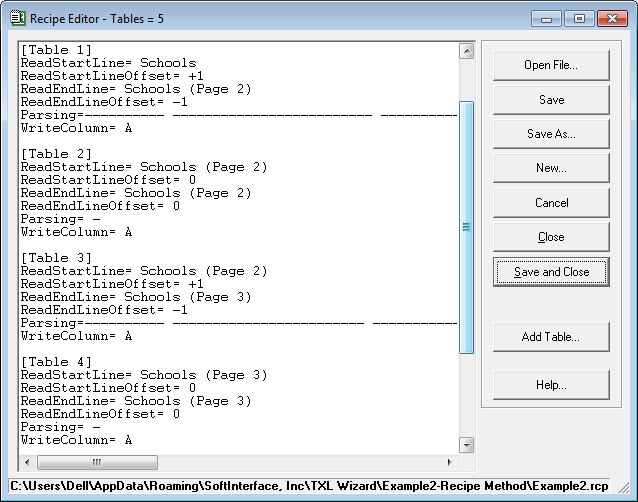
One simple way to create (or edit) a recipe is to use the Recipe
Editor from the edit menu or a simple text editor such as Windows
Notepad.
- Recipe File name: *.rcp where * is any legal file name
- Example Recipe file to illustrate file format
FILE CONTENTS
COMMENT
[Header]
;Header Section ID
Product=TXL-B
;Do not change
FileType=RECIPE
;Do not change
FileFormat=1.1
;Do not change
[Table 1]
;Table 1 Section ID
ReadStartLine=INCOME STATEMENT ;Find row containing "INCOME
STATEMENT"
ReadStartLineOffset=0
;table starts at the same row
ReadEndLine=BALANCE SHEET ;Find row
containing "Balance Sheet"
ReadEndLineOffset=-1
;table 1 ends one row before end key
Parsing=------------------ ==================== ;Column Template
WriteColumn=A
;Start column in Excel
[Table 2]
ReadStartLine= BALANCE SHEET
ReadStartLineOffset=0
ReadEndLine= END OF REPORT
ReadEndLineOffset=-1
Parsing=-------------- ===============
WriteColumn=A
.
.
.
The above Recipe file will work
correctly for the example text below:
- Example Data (for the above recipe example):
INCOME STATEMENT
ACCOUNT First Second
Quarter Quarter
Revenues:
Sales Products $1,000 $1,000,000
Sales Services $1,000 $1,000,000
Sales Misc
$1,000 $1,000,000
Expenses:
Payroll
$300 $300
Travel Expenses $300 $300
Other
$1,000 $1,000
BALANCE SHEET
Assets:
Account 1st Q 2nd
Q
xxxxxx xx yyyyyy zzzzzz
xxxxx xxxx xxx yyyyyy zzzzzz
xxxxxxxxxx
END OF REPORT
SoftInterface, Inc., your PDF to XLS conversion center.